
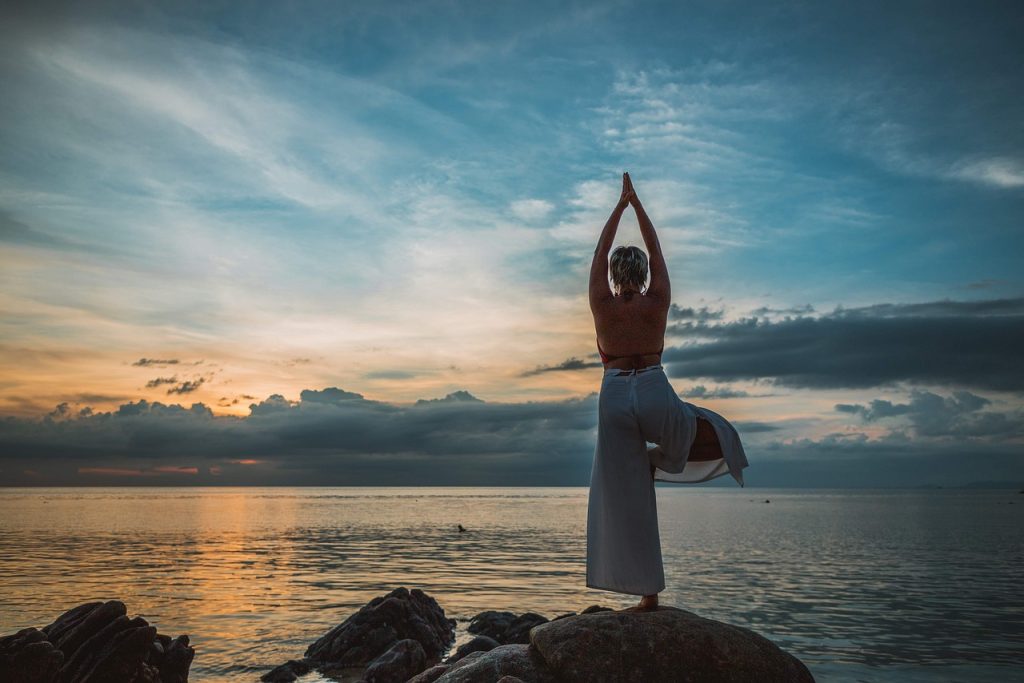
Have you ever watched someone practising Qigong and wondered what they were actually doing?
The movements can look incredibly simple. Slow stretches. Gentle turns. Controlled breathing. Standing quietly and moving with intention.
But there is much more to Qigong than simply moving slowly.
Qigong is an ancient Chinese practice that brings together movement, breathing and focused attention. It is traditionally associated with Traditional Chinese Medicine and the cultivation and regulation of Qi – often translated as vital energy or life energy.
There are many different forms and styles of Qigong, and they can have very different purposes.
One that I have recently become particularly interested in is Shujin Zhuanggu Gong, sometimes described as “The Muscle and Bone Exercise.”
And I think this is a fascinating form of movement to explore as part of self-care.
So, what exactly is Qigong?
Qigong (pronounced chee-gong) is a mind-body practice that has developed in China over thousands of years.
Although there are many different approaches, Qigong generally combines three things:
Body – gentle, controlled movement and posture.
Breath – slow, conscious breathing.
Mind – attention, awareness and concentration.
The idea is that these elements work together rather than being treated as completely separate things.
You aren’t simply moving your body.
You are paying attention to how you move.
You aren’t simply breathing.
You are becoming aware of your breath.
And you aren’t simply standing still.
You are noticing what is happening within you.
The US National Center for Complementary and Integrative Health describes Qigong as involving regulation of the mind, breath, body movement and posture. Movements are generally gentle and smooth, while breathing is often slow and controlled.
For me, that makes Qigong an interesting form of mindful movement.
It encourages us to slow down and reconnect with our bodies rather than constantly rushing through our day.
What is Shujin Zhuanggu Gong?
Shujin Zhuanggu Gong is a specific eight-movement Qigong sequence developed within Professor Zhang Guangde’s Dao Yin Yang Sheng Gong system.
The name is often translated or described as relating to loosening or making the tendons and muscles supple and strengthening the bones.
It is sometimes simply called the Muscle and Bone Exercise.
The sequence consists of eight movements, with the overall practice focusing on mobility, flexibility and strengthening the musculoskeletal system.
And I particularly like the philosophy behind this.
Because self-care isn’t only about what makes us feel good in the moment.
Sometimes self-care is about looking after the body we have to live in every single day.
It’s about movement.
It’s about maintaining mobility.
It’s about noticing stiffness rather than automatically ignoring it.
It’s about giving our bodies some attention.
And sometimes, it’s simply about moving gently.
The eight movements
Shujin Zhuanggu Gong consists of eight movements, each with its own traditional name and focus.
They include:
- Strengthen the articulation of the neck
- Push the stone tablet from behind the head
- The rhinoceros looks at the moon
- Bow deeply to dust the boots
- The heavenly crane massages its knees
- Two dragons play in the water
- The phoenix returns to its nest
- The golden cockerel announces the dawn
The names might sound wonderfully mysterious to us in the West, but they are part of a traditional movement system rather than simply eight random stretches.
The sequence works through different areas of the body, including the neck, shoulders, spine, knees and lower body. Descriptions of the form emphasise mobility, flexibility and strengthening of the spine and musculoskeletal system.
And there is something quite beautiful about the way these movements encourage you to pay attention to different parts of your body.
Why call it the Muscle and Bone Exercise?
The name gives us a pretty good clue about the intention behind the practice.
Rather than being primarily about cardiovascular fitness or pushing yourself to exhaustion, this particular Qigong sequence focuses on movement, flexibility and the musculoskeletal system.
The published description of Zhang Guangde’s form explains that the eight movements are intended to make the tendons and muscles more supple and strengthen the bones, while supporting mobility and flexibility.
That doesn’t mean we should think of Qigong as a treatment for medical conditions.
It’s important to make that distinction.
Qigong is a complementary mind-body practice, not a replacement for medical care, physiotherapy or advice from a qualified healthcare professional.
Research into Qigong is ongoing. Some studies suggest it may help with areas such as balance, physical function, pain and wellbeing, but the strength of the evidence varies depending on the condition and the type of Qigong being studied.
So rather than promising that Qigong will fix something, I think it is much more useful to look at what the practice can encourage us to do:
Move.
Breathe.
Slow down.
Pay attention.
Reconnect with our bodies.
Qigong and self-care
This is where Qigong really starts to interest me.
My whole philosophy around self-care is based on the idea that we don’t have to wait until we are exhausted, overwhelmed or falling apart before we look after ourselves.
Make self-care a habit.
And movement can absolutely be part of that habit.
We don’t necessarily need an hour at the gym.
We don’t need to run five miles.
We don’t need to push ourselves until we’re sweating.
Sometimes we can simply give ourselves ten or fifteen minutes to move gently and consciously.
Qigong offers one way of doing that.
You can practise it slowly.
You can practise it mindfully.
And you can use the time to check in with yourself.
How does my body feel today?
Where am I holding tension?
Do I feel stiff?
Can I move comfortably?
What happens when I slow down?
These are all forms of body awareness.
And body awareness is an important part of self-care.
It’s not about doing it perfectly
One of the things I love about gentle movement practices is that they can remind us that self-care doesn’t have to be perfect.
You don’t have to perform the movements beautifully.
You don’t have to be incredibly flexible.
You don’t have to know everything about Traditional Chinese Medicine.
And you certainly don’t have to become a Qigong expert overnight.
You can start simply.
Stand comfortably.
Breathe.
Move slowly.
Pay attention.
And practise.
Because just like any other self-care habit, the magic is often in the repetition.
Qigong, breathing and the nervous system
There’s another reason Qigong fits beautifully into a conversation about self-care: it brings movement and breathing together.
Many forms of Qigong use slow, controlled breathing alongside gentle movement.
And when we deliberately slow down our breathing and movement, we create an opportunity to step away from the constant rush of everyday life.
We’re not scrolling.
We’re not answering emails.
We’re not rushing from one thing to another.
We’re simply here.
Breathing.
Moving.
Noticing.
That doesn’t mean Qigong magically switches off stress or “resets” the nervous system.
But creating moments of calm, mindful movement can be a valuable part of a wider self-care routine.
A different way to exercise
Perhaps this is one of the things I find most appealing about Qigong.
It challenges our idea of what exercise has to look like.
Exercise doesn’t always have to mean pushing harder.
Sometimes less can be more.
Sometimes our bodies need strengthening.
Sometimes they need stretching.
Sometimes they need rest.
And sometimes they simply need us to pay attention.
Shujin Zhuanggu Gong brings together gentle movement, breathing and concentration in a sequence specifically concerned with the muscles, tendons, bones and mobility.
That makes it a really interesting practice to explore if you’re looking for a different way of moving your body.
Could Qigong become one of your self-care habits?
Perhaps.
You don’t have to completely overhaul your life.
You could start with a few minutes.
Try practising when you wake up.
Or before you start your day.
Perhaps after sitting at your desk for a long time.
Maybe outside in the fresh air.
Or as part of an evening routine when you want to slow things down.
The important thing isn’t necessarily how long you practise.
It’s creating the habit of checking in with your body and giving it some attention.
Because this is what self-care is all about for me.
Not waiting until something is wrong.
Not treating our bodies as machines that have to keep going.
But learning to listen.
Learning to notice.
Learning to respond.
Make self-care a habit.
Self-care becomes self-love.
And from there, self-development happens.
And perhaps sometimes, self-care is simply standing still, taking a breath and giving your body permission to move.
A gentle reminder
Qigong movements should be comfortable and adapted to your own abilities. Don’t force a stretch or movement, and stop if something causes pain, dizziness or other concerning symptoms.
If you have an injury, health condition or concerns about your ability to exercise, speak to an appropriate healthcare professional before starting a new exercise practice.
Qigong can complement good healthcare, but it shouldn’t replace medical diagnosis or treatment.
